viernes, 17 de julio de 2015

ORKNEY ISLANDS: EYNHALLOW

From 10 to 15 July I had the great privilege of being part of the crew that went on the second annual trip to Eynhallow, an uninhabited island which belongs to the Orkney archipelago, to help in the study of fulmars. The landscape is characteristic of these type of islands, shared also by Shetland or the Hebrides; mainly fields and moorland although some parts of the mainland have some scattered trees. Here is a pic of the cottage we stayed in.


The coastline facing south (where the cottage was located) is swamped with breeding arctic terns and common gulls, which created an incredible atmosphere of wild noises.

The water is clear as glass


A lot of great and enjoyable experiences in a short period of time. Working with fulmars was fantastic in its own right but the island was also covered with other birds. We recorded a total of 37 bird species, including the ones I really wanted to see, like arctic skua and tystie.

But let´s get started with the protagonist…

The fulmar belongs to the Procellariidae family, which are the most numerous group of birds known as “tubenoses” and this picture shows exactly why.


The fulmars of Eynhallow have been studied since 1950, just after the big expansion of this species started, with the first eggs recorded in 1925 on the island. The leader for the past few years has been Paul Thompson, a professor at the University of Aberdeen and the other two assistants on this trip were Karen Keegan and Georgia Connolly. We managed to recover 2 loggers from two birds and we also tagged 23 other fulmars. It has been a really poor breeding year and we think one of the causes has been the harsh May Scotland has suffered. The loggers fulmars carry will record behaviour information, like their feeding habits and the latitude they move around in. It certainly is fascinating stuff!


                                                                    (Ringed fulmars)


Other protagonists of the islands were the omnipresent oystercatchers and arctic terns. Most of the young had already fledged but probably the ones that failed breeding in May gave it another go since some eggs were still around.


Oystercatcher


(Arctic tern nest with two eggs)

It is a really aggressive species and some of them were dive-bombing us as soon as we went out of the house. Very interesting was to see them interacting with the arctic skuas, although there always is a clear winner…


Skuas are perfectly designed to be agile, fast and deadly, which makes them one of my favourite group of birds. Just outside the house we had a couple of pairs that performed many curious “broken-wing” tricks when you got close to their territory. This gave me splendid opportunities to photograph them at the beach.


(Intermediate and dark phase arctic skuas)

Their equally aggressive relatives, Great skuas or Bonxies, also inhabit the island. Some of them came really close to us just to check us out, but there was one particular bird that viciously attacked us...


I want to finish this post with one of my favourite auks, the Tystie. A bird with a very simple but striking plumage, especially with that bright red covering the legs and even the inside of the mouth.


We saw groups of different sizes along the rocky cliffs…


A fantastic week which has helped me to understand a lot more about the biology of fulmars and that has erased that underappreciated view of Orkney I had. I hope I can explore a bit more of it in the future!


VERSIÓN ESPAÑOLA

Durante los cinco días 10 a 15 de julio he tenido el inmenso privilegio de ayudar a un equipo de la universidad de Aberdeen estudiando los fulmares en la isla minúscula de Eynhallow en el archipiélago de las Orcadas al norte de Escocia. El paisaje es el típico de las Orcadas, de páramos bajos, y en esta foto se ve la casa donde nos alojábamos:

La costa sur de la isla es prácticamente una colonia continua de charranes árticos salpicada con gaviotas canas.

El mar es impoluto:

Muchas experiencias vividas en muy poco tiempo. Tanto por los fulmares como por las demás aves marinas que habitan la isla. Algunas tan especiales como págalos grandes y parásitos, araos aliblancos y frailecillos.
Os presento al protagonista de nuestra visita:

Pertenece a la familia de proceláridos (Procellariidae) y en esta foto se ve muy bien por qué se llaman en inglés “tubenoses”. Los fulmares de Eynhallow se llevan estudiando desde 1950 y en los últimos años el líder de los viajes es Paul Thompson, profesor de la universidad. Los trabajos principales que se han hecho han sido anillamientos de las aves, colocación de gps en algunas ocasiones y estos últimos años la colocación de chips que aportan información sobre la látitud y hábitos alimenticios de las aves.

. . . y aquí posado:

El sonido de fondo todos los días es el de una colonia muy nutrida del bellísimo charrán árctico.

La gran mayoría ahora tenían jóvenes fuera del nido pero quedaba alguna que otra camada de parejas que fallaron a principios de verano:

Es un ave impresionantemente agresiva en defendiendo lo suyo y te ataca nada más acercarte a sus feudos. Una vez un ave llegó a golpearme.  A su vez, sin embargo sufre ataques constantes de sus vecinos los págalos parásitos, otros grandes protagonistas de la isla.
Muy interesante era verlos en acción, atacados por charranes o atacando a los charranes.
Sus primos los págalos grandes también habitan en la isla y se mosquean como pases cerca de su territorio. Hacen amagos de ataques yendo a ras de suelo muy rápido hacia ti con esa mirada tan agresiva.
Los págalos siempre me han resultado aves muy atractivas y especiales, tal vez por su agilidad voladora y por su elegancia, como este págalo parásito de morfo oscuro.
Para terminar uno de mis álcidos favoritos, el arao aliblanco. Un bicho que alegra mucho las costas rocosas con su plumaje tan atrevido. Pocas aves he visto que tenga las partes no emplumadas de un color tan vivo.
Los vimos en solitario…
En grupos meidanos…
Y grupos más grandes…
Una experiencia que me ha ayudado mucho a entender cómo funcionan este tipos de estudios y también a aprender más sobre la biología de los fulmares. ¡Espero que no sea la última vez que visito las Orkney!

lunes, 6 de julio de 2015

¡CHORLITO DORADO AMERICANO NUPCIAL!

Con marea baja la Ría de Villaviciosa es una extensión enorme de fango con muchos sitios alternativos para asomarse sobre trozos diferentes de ella. Sabíamos solamente que en algún sitio de la ría se había visto el día anterior un chorlito dorado americano en plumaje totalmente nupcial pero no sabíamos dónde. Probamos un sitio tras otro. No solamente no dimos con el chorlito sino que apenas vimos otro pájaro. Unos 12 zarapitos reales, dos trinadores, unos 5 archibebes comunes y un grupo distante de unos 35 agujas colinegras en vuelo. Estaba vacío aquello.

Llegamos al último sitio que íbamos a probar - ¡y allí estaba! ¡La única ave a la vista! Estaba lejos pero con el tele a aumento 60 se le veía divinamente. Para entonces la marea subía rápido. El chorlito estaba posado en barro que desaparecía por minutos. Llegó el agua a su rodillas, a sus tarsos . . . pronto iba a volar. ¿Hacia dónde? Detrás había una isla grande cubierta de hierbas donde muchas aves descansan en altamar. Si se va allí, adiós. Despega . . . ¡vuela hacia nosotros y aterriza en un charco al lado! Allí, acercándonos con cuidado y sin romper su distancia de seguridad, pudimos fotografiar la belleza al placer, algunas veces con un correlimos común al lado, también con plumaje nupcial:


Fue un día de pajareo para nunca olvidar, cuando pierdes toda esperanza y de repente aparece lo buscado y se porta como un campeón.

Para terminar esta entrada os dejo con otra foto del alcaudón dorsirrojo que nos esta dando tanto juego aquí últimamente:


El blog va a estar inactivo unas 3 semanas porque hoy parto para las islas Orkney para ayudar en un estudio de fulmares. Una experiencia que tengo muchas ganas de hacer y disfrutar. Os traeré fotos de aquellas tierras


ENGLISH TRANSLATION OF THE TEXT

AMERICAN GOLDEN PLOVER IN SUM PLUM

At low tide the Ría de Villaviciosa is a vast mudflat with various lookout points for scanning different points. All we knew was that the previous day a sum. plum. American Golden Plover had been seen somewhere in the whole estuary but we didn’t know where. We tried one lookout point after another. Not only did we not luck into the AGP we hardly saw any birds at all. About 12 Curlews, 2 Whimbrels, 5 or so Redshank and a distant flying flock of about 35 Black-Tailed Godwits. It seemed almost void of life.

We arrived at the last lookout point of the day - and there it was! The only bird in view!. It was a long way off but the views through the telescope at 60 mag were brill. We settled for that, thinking there would be no photos. By now the tide was rising quickly. The water reached the AGP’s knees, then it flanks . . . It would fly soon. The question was where. Behind was a huge grassy island where many waders wait out the high tide. If it went there it would be the last we saw of it. With the water now tickling its tum, it took off . . . and flew towards us to land in a nearby pool! There, creeping up carefully without spooking it, we were able to take photos at will, sometimes with a Dunlin beside it, also with a touch of summer plumage still.

It was one of those red-letter days, when you’d almost given up hope but then the target bird turns up in the most obliging mood possible.

To wind up this post I leave you with another photo of the local Red-Backed Shrike we’ve been enjoying so much lately

Today I’m off to the Orkney Islands to study Fulmars for a week. More news on my return.

lunes, 29 de junio de 2015

El ave perfecta / The perfect bird

Os voy a presentar a unos muy agradables vecinos que tenemos en Asturias. Cómo no, son los alcaudones dorsirrojos, una de las razones por la que decidimos pasar aquí los veranos.


Me atrevería a decir que este bicho está en mi top 10 de aves. Todas sus "piezas" están perfectamente encajadas unas con otras. No está saturado con colores, pero tampoco le faltan, tiene el perfecto balance en todos los sentidos. Esa máscara y pico ponen la parte agresiva en un ave que, con ese pecho melocotón, parece dulce y nada maligna.

Y ya, el colmo, es disfrutar de su comportamiento en las praderas. Desde cualquier poste, valla or árbol escanea entre las hierbas con sus poderosos ojos para después avalanzarse sobre su presa.


La hembra es más discreta pero, aún así, tiene su encanto con ese debujo que parecen cenefas en el pecho.

Esta pareja acaban de ser padres y las tareas de alimentación ya son frenéticas. ¡Les deseamos mucha suerte para que saquen adelante todos los pollitos que puedan!


English translation of the text:

Meet one of our most agreeable neighbours here in Asturias. I am speaking, of course, of the Red-Backed Shrike, one of the prime reasons we decided to summer here.

I rate this bird in my top ten. All its parts fit together so perfectly, blending into each other or setting each other off a treat. The hooked beak and black mask hint at aggression and highway robbery while the peach-coloured breast belies this with butter-wouldn’t-melt-in-the-mouth tenderness. It has all the bases covered.


Its behaviour in the bushy meadows where it lives is also fascinating to watch. With its upright stance atop a post or bush it is continually on the lookout for any prey to swoop down onto.

The female is duller but still has a lovely undulating friezework running across the breast.


This pair’s young have just hatched and they are feeding them frenetically. Let’s hope they can turn out as many chicks as possible to continue the line!


viernes, 19 de junio de 2015

Aves alpinas / Alpine birds

Llevábamos una semana y media esperando a que el tiempo se volviese más estable para poder subir a la alta montaña y disfrutar de aves tan especiales como treparriscos, gorriones alpinos o acentores alpinos.

Acentor alpino

Empezamos el día con el treparriscos, pero, tristemente, solo se dejó ver una vez volando a pocos metros de donde estábamos nostros para luego enzarzarse en una pelea con un gorrión alpino y desaparecer. 

Así, decidimos centrarnos en los demás protagonistas que no tenemos en Extremadura o Aberdeen, los acentores alpinos y gorriones alpinos.

Los gorriones estaban por todos lados. Los jóvenes siguen en los nidos y los padres, tanto machos como hembras, no hacen más que llevar comida de acá para allá.


Qué bichos tan apuestos. Todas las aves que son alpinas/nivales/árticas tienen un cierto atractivo especial...


Los otros protagonsitas del día ya tenían los pollos fuera del nido, y estaban por todos lados. 
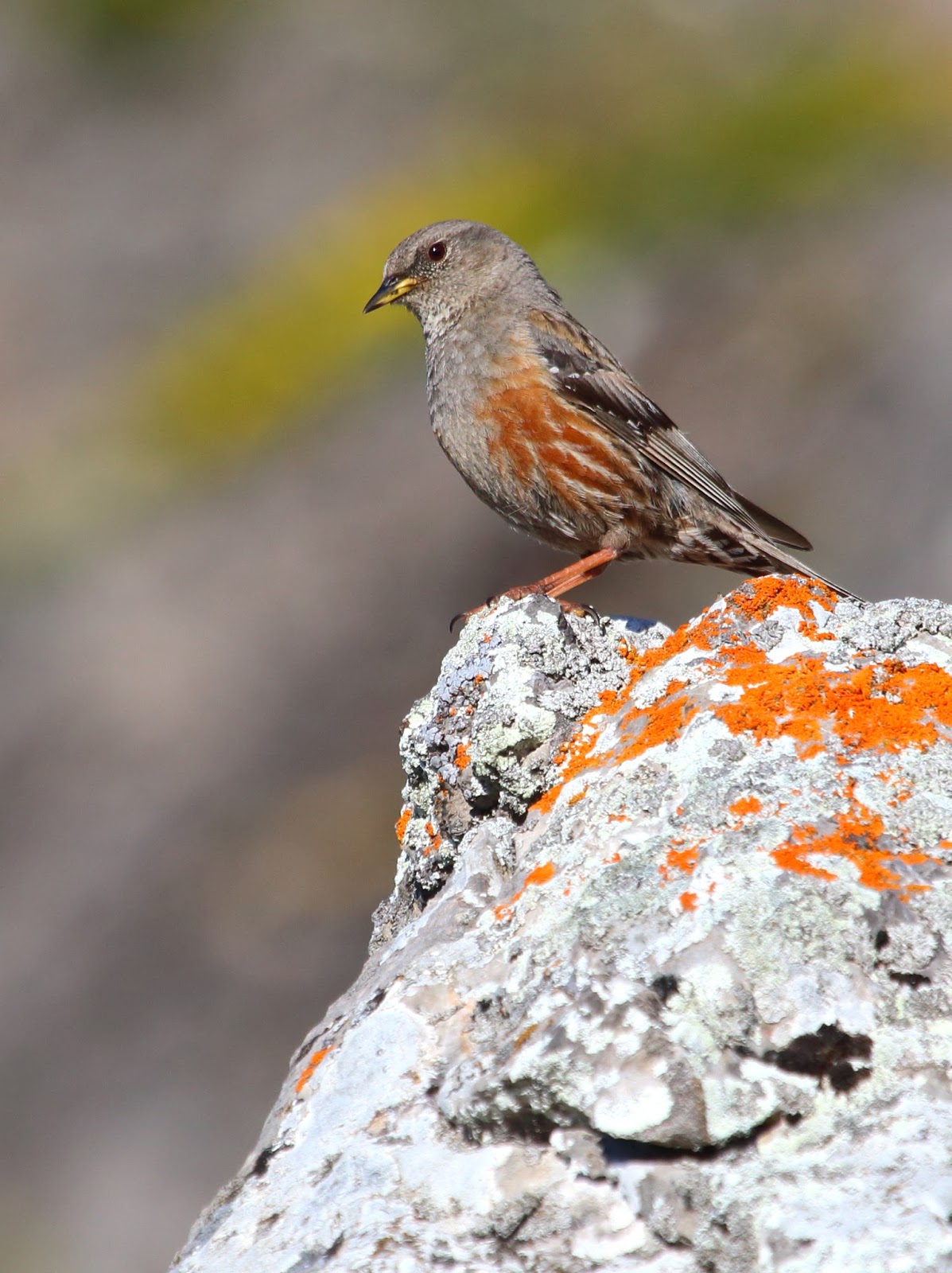
Aquí vemos a un recién volado acentor alpino que, aunque sosillo ahora, se pondrá guapo al año que viene como sus progenitores.


Este jovencillo, a parte de ser volantón ya, ha dado un paso más allá y ahora es capaz de levitar también. ¿Evolución?


Los adultos son realmente elegantes y muy diferentes de sus primos los acentores comunes que, a parte de ser más coloridamente apagados, son más pequeños.


Sus flancos naranjas combinan con los líquenes de la rocas alpinas...

Y para terminar un fotillo de uno de ellos que se acercó un poco más


English translation of the text:

ALPINE BIRDS

After a week-and-a-half wait the weather last weekend was at last settled enough to make a high-mountain trek here in Asturias in search of such special birds as Wall Creeper, Snow Finch and Alpine Accentor.

We saw a Wall Creeper as soon as we arrived. Sadly, it was only one brief sighting, however, flying over the meadows close to us before a mid-air skirmish with a Snow Finch, whereupon it disappeared for good. 

We therefore switched our attention to the other high-mountain birds that are impossible to see in Extremadura or Aberdeen, the Alpine Accentors and Snow Finches.

The Snow Finches were extremely visible. The youngsters are still on the nest and the adults were flying back and forth all morning with food.

They’re such smart birds. All the alpine/artic birds seem to have this special charm...

The Alpine Accentors, equally visible, were feeding their fledglings outside the nest. 

The fledglings lack the adult’s colourful plumage at the moment but they’ll be just as striking as their progenitors come next spring.

One youngster, as well as learning to fend for itself outside the next, also seemed to have learned the art of levitation . . . Evolution?

The adults are really elegant birds, bigger than their commoner cousin, the Dunnock, and much more brightly coloured.

Their orange flanks match the orange rock lichen so nicely...

The final photo is of an adult that dared to come a little closer to us.


martes, 16 de junio de 2015

EL AVE FANTASMA

Todos los veranos dedicamos algunas noches a los chotacabras grises en Asturias, cerca de Arriondas. Son aves que tienen algo especial. Tal vez su aspecto prehistórico o sus hábitos nocturnos.


La noche pasada tuve una de las mejores experiencias pajariles de mi vida. Pude disfrutar de un chotacabras a escasos metros de donde yo estaba, posado en un poste al lado de la carretera. El ave se mostraba muy tranquila, cazando polillas todo el rato y parándose de vez en cuando para emitir su característico canto monótono pero icónico.


Y, a parte de estos postes, también utilizan mucho carreteras y caminos. No me explico por qué, tal vez las utilicen para cazar o para aprovechar el calor del asfalto. 


Una noche estupenda, con un ave estupenda y un comportamiento estupendo...


English translation of the text:

THE NIGHT-TIME PHANTOM

Every summer here in Asturias we spend a couple of evenings trying to get to grips with the local Nightjars. They’ve got something special these birds. Maybe it’s their prehistoric look or their night-time habits.

Last night I had one of the best birding experiences of my life. I was able to enjoy a Nightjar perched on a roadside post only a few metres away. I didn’t show any nerves at my nearby presence, continuing to launch itself for moths and land again on the same post. Every now and then it gave a burst of its characteristic drumming song.

Apart from the posts, they also tend to land on roads and tracks. Christ known why; maybe they use it as a hunting platform or they take advantage of the warmth of the asphalt. 


A splendid night with a splendid bird performing splendidly.

martes, 9 de junio de 2015

UN AVE BELLA Y COSMOPOLITA

La ave protagonista de esta entrada, una de las más hermosos de Europa sin lugar a dudas, se deja ver en los tres sitios donde vivo durante el año. En Aberdeen. Escocia, es común de paso, y seguramente cría en los bosques caducifolios de alrededor, aunque no he encontrado uno todavía. En La Vera, Extremadura, 2.000 kilómetros al sur, crían algunas parejas en robledales a partir de uno 900 metros, casi nunca más bajo.  En Asturias oriental, donde estoy ahora, cría al nivel de mar en los pueblos. En todos los pueblos, incluso los grandes como Arriondas y Cangas.
Se trata del bellísimo colirrojo real.


El macho, como se ve en la foto, tiene la cara negra, el pecho naranja, la frente blanco, el dorso gris y la cola y obispillo rojizos. De ahí su nombre en español, y también en el inglés “Redstart” porque cuando comienza a volar la cola roja es siempre lo que primero se ve.

Es un pájaro muy cantarín. Hay algunos machos que casi no paran de cantar desde que llegan a mediados de abril hasta que los pollos se emancipan a mediados de junio. Es uno de nuestros imitadores más habilidosos. Escuchando un rato a un macho en pleno canto se puede identificar imitaciones de 10 ó más especies diferentes. Y cuando canta, por si los colores que ya tiene no fueran suficientes, luce el amarillo brillante del interior de su boca, casi el único color que le falta fuera.


Esta pareja, como muchos, está criando en uno de los típicos hórreos de Asturias. Antes de entrar en el agujero donde tiene su nido, el macho se suele posar en una de las piedras de apoyo del hórreo…


. . . muchas veces con comida para llevar a los pollos.


A veces, para cambiar, se posa en la barandilla.


Aquí vemos al macho entrando el nido . . .


 . .  y aquí asomándose para salir . . .


La hembra, que también suele posarse al llegar en la piedra de apoyo . . .


 . . .  y también trae comida a los pollos . . .  


es más apagada que el macho, con colores y dibujo más difuminados.
Es un ave que también hemos visto encima del círculo polar en Finlandia, así que es cosmopolita de verdad. Y bonita donde las haya.


English translation of the text:

A COSMOPOLITAN BEAUTY

The star of this post, surely one of Europe’s handsomest birds, can be seen in the three very different places  I live in throughout the year. In Aberdeen, Scotland, it’s a common passage migrant and must surely breed in the surrounding deciduous woods, though I haven’t run into one yet. In La Vera, Extremadura, 2000 kilometres to the south, the odd pair breeds in the hillside oakwoods above c. 900 metros. In Eastern Asturias, where I am now, it breeds at sea level in the towns and villages. In all the towns and villages, even the bigger ones like Arriondas and Cangas.

The bird in question is the gorgeous Redstart.

The male, as you can see from the first photo, has  a pitch-black head, fiery orange breast, white forehead, slate-grey back and reddish rump and tail. Hence its name “Redstart”, presumably, because red is the first thing you see whenever it starts to fly.

It’s an indefatigable songster.  Some males hardly stop singing from the moment they arrive in mid April to the time the offspring leave the nest in mid June. It’s also one of the most skilful mimics. A bird in full song might well imitate 10 or more other species if you listen to it for a while. And when it sings, as if its colours weren’t enough already, it shows off a bright yellow gape.

The pair in these photos, like many others, is breeding in one of Asturias’s typical rat-proof grain stores called “hórreos”. The male, arriving at the nest, usually perches first on one of the hórreo support stones, often with food in the beak for the youngsters. Sometimes, just for a change it will perch first on the handrail. Then it pops into the nest, a gap in the wooden part of the building, the photos showing it entering and leaving the nest hole

The female, of much duller plumage, also usually perches on the support stone before entering the nest, also often bringing food for the young.

It’s a bird we’ve also seen way above the arctic circle in Northern  Finland, so it really is cosmopolitan in range. And lovely like few others.