Mostrando entradas con la etiqueta Serreta chica. Mostrar todas las entradas

lunes, 9 de noviembre de 2015

Serreta chica, mosquitero de Pallas y más!

Parece que el invierno por fín está llegando a Escocia. Las primeras nieves ya dominan el interior y las temperaturas bajan a números individuales. Aquí en Aberdeen hemos tenido bastante lluvia y viento estos últimos días, aunque hace aproximadamente una semana pudimos disfrutar de uno de los últimos raros migrantes del otoño, un mosquitero de Pallas.

Ante de llegar al sitio nos familiarizamos con el reclamo de este pequño mosquitero, y !menos mal que lo hicimos! Nos costó unas dos horas sacarlo de una pequeña zona arbolada en la costa y lo hicimos por reclamo. No pude hacer ninguna foto porque solamente tuvimos vistas muy fugazes, aunque sí pudimos ver las bandas ammarillas en alas y cabeza. ¡Una de mis ambiciones como ave!

Aquí en el reino unido se producen unos eventos que yo en España no he visto, por lo menos en Extremadura. Lo llaman "fall of migrants", que significa caída de migrantes. En estos días, como cuando vimos el mosquitero de Pallas, la zonas costeras se llenan, literalmente, the miles de aves en migración, especialmente zorzales. Lo que más me llamó la atención fue ver cómo llegaban los mirlos provinientes de Europa, fáciles de distinguir porque hembras y jóvenes son mucho más oscuros.

Cientos de zorzales alirrojos estaban en la zona.


Ahora que dejamos el otoño atrás, empiezan a llegar aves del norte de Europa. Ya tenemos por aquí cerca los patos haveldas, negrones, mérgulos y las gaviotas blancas. Pero ayer la sorpresa la dió una hembra de serreta chica, que apareció en el río Don, a 5 minutos de mi casa.


Era muy asustadiza y se asociaba con un par de ánades reales.


Ya se han visto tres serretas chicas por la zona, pero todas jóvenes o hembras. ¡ La próxima espero que sea un precioso macho adulto!


English translation of the text:


SMEW, PALLAS’S WARBLER AND MORE!

Winter seems to have come to Scotland at last. Inland areas are powdered by the first snows and temperatures have dropped to single figures. Here in Aberdeen we’ve had quite a lot of rain and wind in recent days, though about a week ago we were able to enjoy one of the last rare autumn migrants, a Pallas’s Warbler.

Before setting out we genned up on its call. And just as well! It took us two hours to find it in a small bushy area of the coast and in the end we tracked it down from its call. I couldn’t get any photos because the views were fleeting but we did see the yellow stripes on wings and head. One of my ambition birds ticked off!

Here in the UK there is a phenomenon called "fall of migrants", which I’ve never seen in Spain, at least in Extremadura. In these recent days, when we saw the Pallas’s, the coast literally fills up with thousands of migrating birds, especially thrushes. The most striking feature was the number of Blackbirds arriving from Europe, easily distinguishable because the females and young are much darker.

Hundreds of Redwings were in the area.

Now that we’re leaving autumn behind, the first northern birds are coming back. Long-Tailed Ducks, Scoters, Little Auks and Whitewingers have all clocked in. The surprise package yesterday was a female Smew, a Redhead, which turned up on the River Don only 5 minutes from my house.
It was very shy and hanged out with a pair of Mallards.

I’ve now seen three Smews around here, all juvs or females. Let’s hope the next one is a stunning adult drake!


martes, 2 de junio de 2015

De patos árticos a vencejos meditteráneos / From arctic ducks to Mediterranean swifts

Lo bueno de vivir durante el año en tres sitios tan sumamente diferentes como el norte de Escocia (Aberdeen), el centro de España (Extremadura) y el norte de España (Asturias) es que ves una gama muy variada de aves.


(Vencejo cafre)

Con el permiso de otras delicias como colimbos y charranes, las estrellas de los primeros 8 meses en Aberdeen han sido los patos, con eíderes por un tubo . . .


. . . eider real


 . . . pato arlequín


. . . porrones bastardos 


.
. . . y las tres serretas


Les echaré de menos estos meses de verano.

Cuando salí de Aberdeen la semana pasada los vencejos comunes acababan de llegar para llenar el cielo con sus gritos. Llegado en Extremadura, los vencejos de aquí han sido casi los primeros en llamarme la atención. En esta parte de España hay algunas pocas parejas del Vencejo Cafre. Llegan tarde, como pronto finales de abril, y luego buscan un nido de Golondrina Dáurica para echar al inquilino y apoderarse de una casa ya hecha, poniendo una pluma blanca en la entrada como una bandera de conquista. En vuelo se ve muy bien la forma de vencejo pero con un bonito obispillo blanco.


Mucho más comunes por aquí son los magníficos Vencejos Reales. Son los más grandes de su género y crían tanto en roqueda como en construcciones humanas como puentes y castillos. Son majestuosos voladores:


La semana que viene a Asturias. A ver si nos caen los Alcaudones Dorsirrojos, Treparriscos y Gorriones Alpinos de otros años, que difícilmente se ven en Aberdeen o Extremadura.


English translation of the text:

FROM ARCTIC DUCKS TO MEDITERRANEAN SWIFTS

The best thing about living at different times of the year in three such different places as northern Scotland (Aberdeen), the centre of Spain (Extremadura) and the north of Spain (Asturias) is that you see such a wide range of different birds.

Over and above other delights like divers and terns, the star turns of my first 8 months in Aberdeen have been the various species of arctic and subarctic ducks, with huge rafts of Eiders plus King Eider, Harlequin Duck, Scaup and the three sawbills  . . .

I’ll miss them all this summer.

When I left Aberdeen last week the first Swifts had just arrived, filling the evening skies with their screams. Back in Extremadura, the swift species of hereabouts were among the first to catch my attention. In this part of Spain there are a few scattered pairs of White-Rumped Swifts. They are late arrivers, at the earliest by late April. When they get here they search out a Red-Rumped Swallow’s nest to kick out the rightful owners and set up shop inside, sticking a white feather in the mouth of the taken-over next like a victory pennant. In flight they are obviously swift shaped but sporting a neat white rump.

Much more common around here are the magnificent Alpine Swifts. They are the biggest of their gender and breed both on natural cliffs and rocks and man-made constructions like bridges and castles. They are majestic fliers.


Next week, we’re off to Asturias. Let’s see if this year we’re lucky enough to see the Red-Backed Shrikes, Wallcreepers and Snowfinches of other years, species that are very difficult to see in Aberdeen or Extremadura.

viernes, 28 de noviembre de 2014

¡SERRETA CHICA Y MÁS!

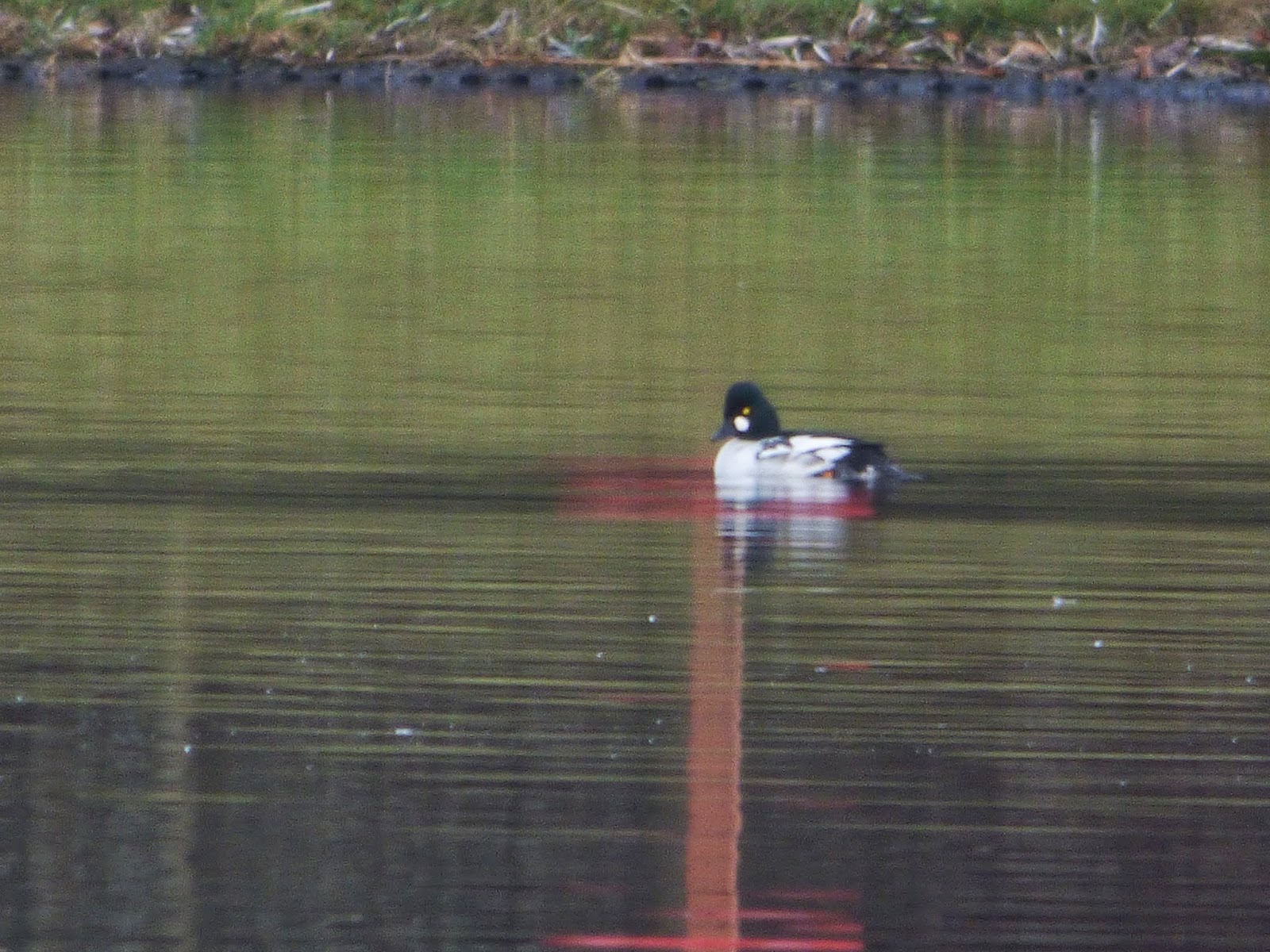
El pasado domingo apareció un serreta chica en un embalse al sur de Aberdeen, así que el lunes fui para allá. Sin duda alguna, es una de las aves que está en mi top 20, especialmente los machos, aunque en este caso era una hembra/joven.

Fue muy fácil encontrarla, aunque la distancia era grande, y cuando decidió acercarse la luz era muy mala. Aun así simepre es increíble ver una especie como esta.


En el lugar también había preciosos machos de porrón osculado, una especie que, a pesar de ser abundante, es de los patos más bonitos.


Después de esta rápida visita, como el día era tan bueno, me fui a la playa y hubo dos sorpresas muy agradables. La primera de ella fue el avistamiento de la familia de delfines mulares que vive en la zona. En total, unos 8-10 delfines nadando hacia el sur.


Y a la segunda sorpresa casi la piso! Un cachorro de foca gris estaba descansando en las rocas.


Un muy buen día con muy buenos avistamientos.


English translation of the text:

SMEW AND A GOOD SUPPORTING CAST

On Sunday 21 November a smew turned up on a nearby reservoir so on the following Monday I paid a quick visit. It’s without doubt one of my top-20 birds, especially the drakes, though this individual was a female/youngster.

It proved easy to find but kept its distance. The only time it came a bit closer the light was bad. Even so, it’s wonderful to see this magnificent bird so close to home.

On the same reservoir there were also some gorgeous drake goldeneyes, a much commoner duck but no less beautiful.

After this quick visit I decided to make the most of the good weather by nipping to the beach, where I had two very agreeable surprises. The first was a lovely sighting of the local bottlenosed dolphin family, a pod of about 8-10 steaming southwards just off the coast.

The second surprise I almost trod on!! A grey seal pup hauled out on the rocks.
Another very good day of wonderful sightings.