Mostrando entradas con la etiqueta Alca. Mostrar todas las entradas

sábado, 9 de mayo de 2015

¡AHORA SÍ! / PUFFINS GALORE!

No se ni como empezar esta entrada de todas las fotos y aves que tengo que mostraros. Voy a empezar con un aperitivo del que fue el protagonista del día, aunque seguido de cerca por otras aves.


(Frailecillo atlántico)

Ayer volví a casa con 1200 fotos. Alguien me tiene que controlar cuando voy a estos sitios porque me vuelvo loco con tanto pájaro. Las colonias de aves marinas te atrapan con sus sonidos y olores. Ayer salí de casa a la 1 y volví a las 9. 

Antes de visitar la colonia hice una parada rápida en el estuario del Ythan, donde pude ver al eider real no muy cerca y donde fui recompensado con una pareja de charrancitos pescando muy cerca.


Era la primera vez que he disfrutado de estas golondrinas del mar tan cerca. Su forma de pescar es bastante más delicada que la de otros charranes, dejandose caer sobre el agua y cogiendo peces de la superficie.

Después de esto me fui a la colonia de aves marinas Bullers O´Buchan, donde mi principal objetivo eran los frailecillos y que voy a dejar para el final.

El día fue bastante ventoso, lo que daba muchas oportunidades para hacer fotos en vuelo de alacas y araos sobre todo.


Son verdaderos misiles que, a veces, te pasan volando a menos de 1m!

En un par de sitios los araos están encima de los acantilados y te dejan acercarte todo lo que quieras. 


Te quedas maravillado mientras disfrutas de estas aves a escasos metros. Hubo un arao que lleguó volando y se posó justo en el límite de mi distancia de enfoque...


Ese color y textura de chocolate que tienen es tremendo.

Seguimos ahora con sus primas las alcas, que para mí están ahí en el top 3 junto con el frailecillo y arao aliblanco en el ranking de aves marinas.


Las alcas son las terceras más comunes de los alantilados después de los araos y gaviotas tridáctilas, aunque no tiene problemas para compartir piso.

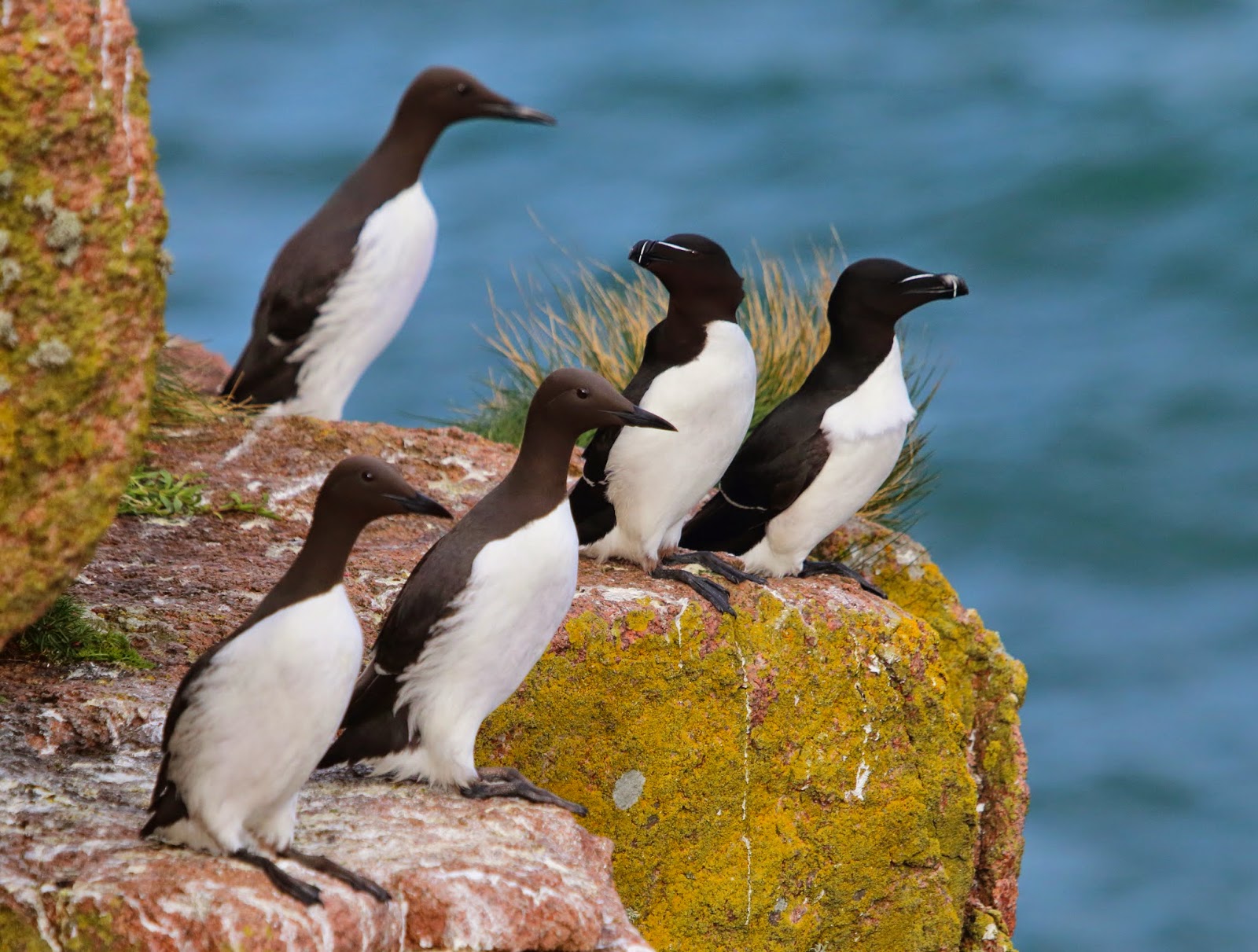

Las alcas prefieren la parte alta de los acantilados, lo que te da bastante oportunidades para verlas de cerca.


Bueno, creo que ya es hora de presentaros a los protagonistas del día, los preciosos duendecillos del mar, que cada vez que los veo me sorprenden por su pequeño tamaño.


Se empeizan a congregar en los acantilados sobre las cinco, que es cuando vuelven de pasar el día en el mar pescando.


No me puedo quejar de lo afortunado que soy al tener estos espectáculos tan cerca de casa.


Esta entrada llega a su fín. Ya me queda menos de un mes por estos lares antes de volver a España en verano.


English translation of the text:

I hardly now how to begin this post, I’ve got so many bird photos to show you. I’ll start with a trailer of the star of the day, albeit closely followed by other goodies.

Yesterday I got back home with 1200 photos. These places send me snap happy. Seabird colonies bewitch you with their sounds and colours. I left home at 1 and got back at 9.

Before visiting the colony I dropped into Ythan estuary, where I saw the king eider in the middle distance and I was rewarded for the visit by a pair of little terns fishing nearby. It’s the first time I’ve seen these gorgeous seaswallows so close up. Their fishing strategy is much more delicate than the other terns, swooping down and grapping fish fry from close to the surface.

Then I made my way to the seabird colony at Bullers O´Buchan. My main target bird was the puffin, so I’ll leave it till last.

The day was pretty windy, giving me many chances to snap razorbills and especially guillemots in flight.

They shoot by like missiles, sometime passing closer than 1m!

In a couple of places the guilles are right on top of the cliffs and let you come as close as you like.
They’re stunning birds to see so close up, with their rich chocolate-brown livery. One flew in while I was there and perched right on the inner limit of my focus range.

The next photos are of their cousins, the razorbills, for me one of the top 3 seabirds along with puffin and tystie.

The razorbills are the third most common cliff residents after the guillies and kittiwakes, although they’re quite prepared to share the same ledge, as the photos show.

The razorbills prefer the higher part of the cliffs, making them easier to photograph.

So, after this long preamble, enter the star of the day, the wonderful sea gnome, the puffin. Every time I see them I’m surprised how small they are.

They start coming into the cliffs at about 5 pm after spending all day fishing at sea.

I really can’t believe my luck at having these stunning birds so close to home.

So this post comes to its end. I’ve now got only one month left until going back to Spain in summer.

sábado, 25 de abril de 2015

Bullers O´Buchan. Aves marinas

El día que hice las fotos al eider real también tuve la oportunidad de ir a una colonia de aves marinas situada un poco más al norte del estuario.


La colonia acoge a unas 10000 gaviotas tridáctilas, 10000 araos, 2000 alcas, 1000 fulmares y, las estrellas, unas cuantas decenas de frailecillos.

Las "malas noticias" son que los frailecillos aún no estaban en los acantilados porque los usan como dormidero antes de comenzar a criar. Sí que pude disfrutar de una decena más o menos, pero todos volando o posados en el mar. Esto solo significa que se merecen otra visita.


Aún así, fue todo un espectáculo poder disfrutar de las idas y venidas de los fulmares.


O de los sonidos de las gaviotas tridáctilas, de las cuales, a parte de las fotos, pongo un video para que las podáis escuchar.


Otros de los sonidos característicos son los fulmares con sus voces graves y territoriales.


No nos podemos olvidar de los omnipresentes araos, algunos de ellos "embridados".


Y otros pasando como verdaderos misiles


Los cormoranos y moñudos también crían allí. Aquí uno de ellos transportando material al nido.


Y para terminar, uno de sus primos, un comrmorán grande que pasó cerca de los acantilados.


English translation of the text:

BULLERS O´BUCHAN.  SEABIRDS

The same day I took the photos of the King Eider, I also had the chance to go to a seabird colony a little north of Ythan Estuary.

The colony is home to about 10,000  kittiwakes, 10,000 guillemots, 2000 razorbills, 1000 fulmars and, the star turn, a few dozen puffins.

 The "bad news" was that the puffins only roost on the cliffs until they star breeding. I was able to enjoy about ten or more, but all flying or swimming in the sea. This means another visit is due to see them on the cliffs.

Even so, it was stunning to watch the fulmars swooping in and out of the cliffs.

 The kittiwakes also kept up a magnificent racket. You can get some idea of this from the video.
 The fulmars have their own characteristic calls, deeper and territorial.

The guillemots, some of them bridled, kept up their own show on the ledges while others shot by like missiles.

Cormorants and shags also breed there, one of the shags bringing in material for its nest.


jueves, 26 de marzo de 2015

Alcas, tridáctilas y fulmares...

Hace poco me comentaron las presencia de una pequeña colonia de aves marinas justo al sur de Aberdeen, por lo que el miércoles, después de hacer unos recados en el centro de la ciudad, me fui para allá. Han sido 5 los años que hace que no visito un colonia de estas aves y, aunque pequeña, esta me ha hecho sentir todas las sensaciones que me transmitieron en su día colonias más grandes.

El sonido, el ambiente e incluso el olor, todo forma parte de algo que no se puede describir. Estuve 4h en los acantilados y 2 de ellas me las pasé sentado en el borde, simplemente contemplando el espectáculo.


En total calculé a ojo unas 1500 alcas, 50 fulmares, 800 araos y unas 500 gaviotas tridáctilas.


(Fulmar)

Los sonidos es, probablemente, lo mejor de un sitio así. Las gaviotasa tridáctilas no callan, los araos no dejan de emitir esos sonido que recuerdan a un padre cabreado con su hijo por sacar malas notas y, mientras, por lo bajo, se escucha a las alcas con su graves voces hablar entre ellas.

(Alcas vistas desde arriba)

Con un poco de suerte encontré un punto en el acantilado donde las alcas estaban bastante cerca. Lo mejor de estas aves es que no les importa la gente y, normalmente, en estos sitios las gente es muy respetuosa.

Primero una...


Luego se apuntarón más al show...


Las alcas comparten piso con otras aves en los acantilados. Algunas con tridáctilas...


Otras con araos...


Y otras con vecinos más extraños como este eider...


Seguimos con las gaviotas tridácticlas. Para mí una de las mejores gaviotas sin duda.


Los araos eran, con diferencia, los más difíciles de fotografiar...


También era precioso ver a los fulmares planear por encima de los acantilados con una facilidad y delicadeza que muchas aves querrían tener. Se nota que son familiares de albatros...


Para terminar unas fotitos de las alcas otra vez, pero con una luz menos dura.


Todo esto en un día con un tiempo estupendo y en un sitio literalmente andable desde el centro de la ciudad. El sueño de cualquier pajarero, Aberdream.

Para que os hagáis una idea de lo cerca que están.


English translation of the text:

RAZORBILLS, KITTIWAKES AND FULMARS

I recently heard about a small seabird colony just south of Aberdeen. Last Wednesday, after a bit of shopping in the city centre, I decided to make my way there. It’s been five years since I last saw a colony of these birds and though this one is small, it revived in me all the thrills and feelings of the bigger colonies I’ve enjoyed in the past.

The sound, the sight and even the smell, all form part of an ineffable experience. I spent 4 hours on the cliffs and 2 of these I just sat there on the edge enjoying the spectacle.

My rough estimate was about 1500 razorbills, 50 fulmars, 800 guillemots and 500 kittiwakes.
It’s the sounds that are probably the best sensation of all. The kittiwakes never stop giving their onomatopoeic call, the guillemots unleash those ghoulish screams like a parent aghast at their children’s school report (whaaaaaatt!!!!) while the razorbills keep up their deeper grunts in the background.

I was lucky enough to find part of the cliff where the razorbills were pretty close. The best thing about these birds is that they’re quite tame and the people in these areas are usually careful not to startle them.

The first shots are of a single bird and then a few together. They often share shelves with other birds on the cliffs like kittiwakes and guillemots. At some times they also have odder bedfellows like an eider...

The kittiwakes, in their own right, are for me one of the best gulls of all.

The most difficult to photograph are without doubt the guillemots.

It was also a delight to watch the fulmars gliding over the cliffs with an ease and grace that betrays how closely they are related to the albatross.

I wind up the post with some other phots of the razorbills with kinder light.

And all this with wonderful weather and at a walking distance from the centre of the city. The dream of any birder: Aberdream.


Finally a map to show how close the colony is the city.